Open Code, Closed Doors: A Deep Dive into the Great AI Divide
The Narrative Hook: A Ghost in the Machine
It’s the height of the holiday season, and inside the bustling headquarters of a global retailer, artificial intelligence is the central nervous system of its logistics. Millions in revenue hang in the balance as AI models forecast supply, optimize shipping routes, and dictate warehouse staffing. Suddenly, a senior executive, staring at a logistics report, asks the simple question that cuts through the hum of the operation: “Why did the AI prioritize shipping to the East Coast over the Midwest this week? Show me the audit trail.”
Panic ripples through the analytics department. The AI’s logic is a ghost in the machine, its decisions leaving multi-million dollar footprints but no tracks. In one version of this story, the team consults its closed-API partner and is met with polished dashboards showing performance metrics but no answers; the “why” is locked away in the vendor’s black box. In another version, an internal team using open-source models produces a detailed report, tracing a reproducible path from input to outcome. They can explain the decision because they can see inside the machine.
This is the choice confronting enterprises everywhere. How does a business choose between the promise of stability and the necessity of transparency? What does this choice—between a system you can easily use and one you can fully understand—mean for the future of business, accountability, and innovation?
The Core Concept: Decoding the Digital DNA
Before dissecting the complex trade-offs that define this choice, it's crucial to understand the fundamental architectural difference between open-source and closed-source AI. This isn't just a technical distinction; it's a philosophical one that shapes everything from cost and security to the very pace of innovation.
So, what's the difference?
- Open-Source AI refers to systems where the source code—the program's underlying instructions—is publicly available for anyone to examine, modify, and distribute, as seen with models like Meta's Llama 2 and OpenAI’s CLIP.
- Closed-Source AI, also known as proprietary AI, refers to systems where the source code is kept confidential, like a closely guarded trade secret. These models power tools from companies like OpenAI (GPT-4) and Google (Gemini).
The "Real World" Analogy: The Community Cookbook
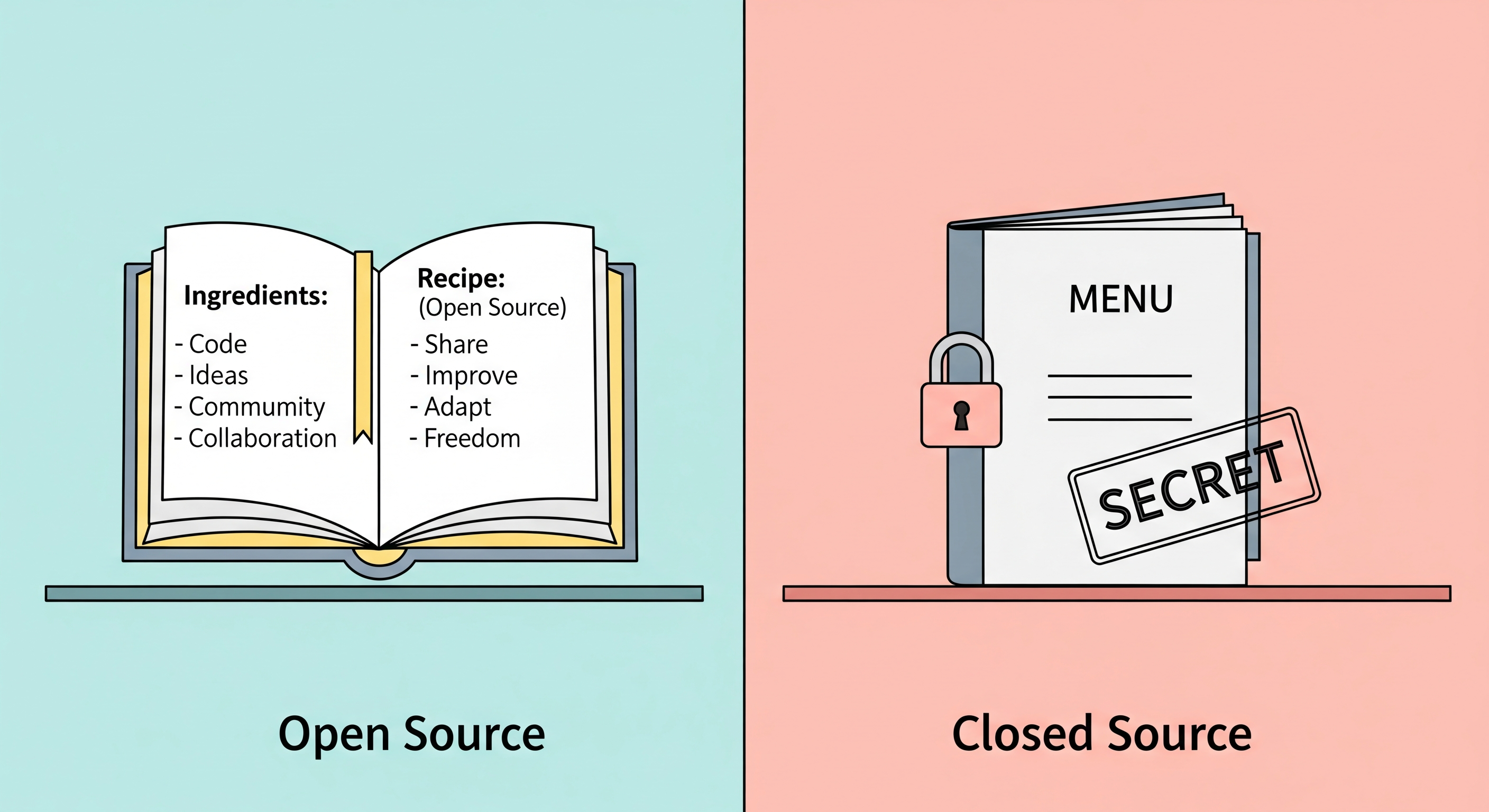
To illustrate this, think of open-source AI as a community cookbook. The recipes are available for everyone to see, use, and share. A chef can take a recipe, adapt it for their restaurant, improve it, and even share their new version back with the community. In contrast, closed-source AI is like the secret family recipe from a world-famous restaurant. You can enjoy the spectacular final dish, but you will never know the exact ingredients or the precise steps used to create it. You simply have to trust the chef.
This fundamental difference in access impacts every dimension of an AI strategy. Now, let's explore how this chasm plays out across the most critical aspects of developing and deploying AI.
The Deep Dive: Unpacking the Trade-Offs
The choice between open and closed source is not a simple technical decision but a strategic one involving a series of critical trade-offs. It requires a business to weigh its priorities, from budget and technical expertise to long-term goals and risk tolerance. This section dissects these trade-offs thematically to provide a comprehensive understanding of what's at stake.
The Philosophy of Access: The Glass House vs. The Black Box
The Explanation The most profound difference lies in transparency. Open-source models allow developers to "peek inside" and understand how they work, which fosters a culture of accountability and trust. In contrast, closed-source models are often described as a "black box." Users have limited visibility into the algorithms and data handling practices, which can raise serious accountability concerns. Yet, this transparency has its own nuances. As Dr. Mark Nitzberg of UC Berkeley points out, even with open-source models, you "get the weights, but not the actual data that was used to produce the weights." This means that even when you can inspect the final product, "what happened to make the underlying beast is still unknown to you," leaving layers of opacity.
The "Real World" Analogy: The Supercar vs. The Sedan
Imagine an open-source model as a modern supercar with a glass engine cover and a publicly available repair manual. An enthusiast can see every part, understand how it functions, and even modify it for higher performance. This openness builds a community of experts who collectively understand the machine. A closed-source model is like a luxury sedan where the hood is sealed by the manufacturer. It runs beautifully and reliably, but only certified technicians can access its inner workings. You don't need to know how it works, but you must trust the manufacturer's process completely.
"Zoom In": Auditability
In highly regulated sectors like finance and healthcare, the ability to trace data lineage and explain AI-driven outcomes is not just a feature—it's a core requirement. The retailer scenario highlights how regulatory pressure can turn the transparency of open-source from a "nice-to-have" into a business necessity. When an auditor or a board member asks for proof of how a decision was made, having an auditable, reproducible path from input to outcome becomes invaluable.
The Engine of Innovation: Community Creation vs. Corporate Curation
The Explanation The two models foster vastly different approaches to innovation. Open-source promotes a collaborative environment where a global community of developers can build upon existing work, accelerating progress for everyone. This path is ideal for companies with the right ingredients: custom data, time, resources, and money. With these assets, a business can fine-tune models for specific applications, like teaching an AI to understand the unique terminology of the banking industry. Closed-source models, on the other hand, offer streamlined implementation and consistent updates curated by a vendor. However, they provide limited flexibility, which can create "migration barriers" or "vendor lock-in," making it difficult and expensive to switch solutions later.
The "Real World" Analogy: Lego Bricks
Think of the open-source ecosystem as a massive, public Lego collection. Anyone can use the bricks to build whatever they can imagine, adapt the creations of others, and contribute new designs back to the community. This leads to an explosion of creativity. Closed-source AI is like a pre-designed Lego kit. It comes with detailed instructions, dedicated customer support, and a guarantee that you can build the model on the box perfectly. It’s an excellent, reliable experience, but you have limited freedom to deviate from the provided plan.
"Zoom In": Fine-Tuning
Fine-tuning is where the power of open-source truly shines for business. This process of adapting a pre-trained model to a specific dataset is the ideal choice when a company has its own custom data, requires a massive return on investment (ROI), or needs a strategic advantage over competitors. For example, a business can fine-tune a model like Llama 2 to understand the specific terminology and context of the insurance industry, creating a customized proprietary system that outperforms generic models.
The Economics of AI: The Price of Freedom vs. The Cost of Service
The Explanation At first glance, open-source models appear to be the clear winner on cost, as they are often "free to use," significantly lowering the barrier to entry for startups. However, "free" does not mean zero cost. Organizations must still account for the associated expenses of setup, customization, maintenance, deployment, and user training. In contrast, closed-source models almost always involve licensing fees and ongoing access costs that, as one client noted, can "add up to a pretty big sum quickly." But these fees often bundle in professional support, routine updates, and maintenance, providing a predictable service.
The "Real World" Analogy: Property Ownership
The cost difference can be compared to acquiring property. Open-source is like being given a free plot of land. The land itself costs nothing, but you are fully responsible for the costs of designing and building a house, connecting utilities, and performing all future maintenance. Closed-source is like renting a luxury, fully-furnished apartment in a managed building. You pay a recurring fee, but maintenance, security, and amenities are all included in the price, offering convenience and predictability.
"Zoom In": Total Cost of Ownership
The most strategic way to evaluate cost is through the lens of Total Cost of Ownership (TCO). The TCO for open-source includes a significant investment in specialized in-house talent and infrastructure. For a company with deep technical expertise, this can pay off by optimizing performance and eliminating long-term licensing fees. For closed-source, the TCO shifts that cost to predictable, but potentially escalating, licensing and usage fees. For a business without a large technical staff, this all-inclusive model might prove more cost-effective in the long run.
The Fortress of Security: Public Scrutiny vs. Private Control
The Explanation The two approaches represent competing security paradigms. The open-source argument is that public scrutiny is a strength: with the code available, the global community can audit it, allowing vulnerabilities to be spotted and fixed collaboratively. Dr. Virginia Dignum compares this to cryptography, where open algorithms have consistently proven more secure. The closed-source counterargument is that a confidential codebase creates a more controlled environment, and vendors are heavily incentivized to ensure security to avoid reputational damage and fines.
The "Real World" Analogy: Town Square vs. Bank Vault
Open-source security is like a public town square. Because it's open, a potential thief might spot a weakness, but there are also thousands of watchful eyes from the community ready to raise the alarm and help fix the problem for everyone. This collective oversight can make the square remarkably safe. Closed-source security is like a private bank vault. Its design is a secret, and only the owner's dedicated security team has access. This secrecy is a form of protection, but if there's a flaw in the vault's design, no one from the outside can point it out; you must trust that the owner's team is flawless.
"Zoom In": Misuse vs. Concentration of Power
The risk of misuse is real. Just days after Meta released its Llama 2 model, uncensored versions were created that could answer dangerous questions, including how to build a nuclear bomb. This illustrates a core risk: once a copy is in the wild, the creator has little control. However, some experts argue this reframes the debate incorrectly. Dr. Dignum contends that harms from open models, like misinformation, are largely scaled versions of existing problems. For her, the more troubling risk is not misuse but the concentration of power. "Closed models do not eliminate harms," she states, "but considerably increase dependency, lack of sovereignty and centralization of control." This insight reframes the security debate from a technical problem to a strategic one about technological freedom and the democratic future of AI.
The "Step-by-Step" Walkthrough: A Tale of Two Startups
To move these concepts from the abstract to the practical, let's follow the journey of two hypothetical startups. Both aim to build an AI-powered customer service chatbot, but they choose different paths.
Path A - "The Customizers" (Open-Source)
This team chooses a powerful open-source model like Meta's Llama. Their journey looks like this:
- Acquisition: They download the model weights for free, avoiding any initial licensing costs.
- Setup & Fine-Tuning: Their in-house developers invest significant time and compute resources to fine-tune the model on years of their company's specific customer interaction data. The result is a chatbot that is a true expert in their niche product.
- The Challenge: During development, they hit a complex snag. They must rely on community forums and public documentation for support, which is helpful but not immediate, causing a minor delay.
- The Payoff: Their final chatbot is a highly tailored, proprietary system. They own it completely, and its specialized knowledge gives them a significant competitive advantage that rivals cannot easily replicate.
Path B - "The Accelerators" (Closed-Source)
This team chooses to build on a closed-source model like GPT-4, accessed via an API. Their journey is different:
- Acquisition: They sign up for a license and receive an API key within minutes. Their costs are variable, scaling based on usage.
- Implementation: Using the provider's comprehensive documentation and user-friendly interface, they integrate the AI into their workflow in a fraction of the time it took "The Customizers."
- The Challenge: They notice the model's responses are sometimes too generic and find they have limited ability to customize its core behavior. However, when they need technical support, they contact a dedicated account manager and receive a swift, professional response.
- The Payoff: They launch their chatbot to the public weeks earlier, allowing them to focus on marketing and sales. They have achieved incredible speed-to-market but remain dependent on their vendor for updates and continued access.
The ELI5 Dictionary: Your AI Terminology Cheat Sheet
The world of AI is filled with technical terms. Here are simple definitions for some of the key concepts discussed in this article.
-
Source Code The set of human-readable instructions that tells a computer program how to function. Think of it as... the recipe for a piece of software.
-
Model Weights The numerical parameters within an AI model that are adjusted during training and determine its ability to perform a specific task. Think of it as... the specific measurements of ingredients and cooking times in the recipe; changing them changes the final dish.
-
Fine-Tuning The process of taking a pre-trained AI model and further training it on a smaller, specific dataset to adapt it for a particular task or domain. Think of it as... taking a master chef's general cake recipe and adjusting it to make the perfect lemon-flavored wedding cake.
-
Vendor Lock-In A situation where a customer using a product or service cannot easily transition to a competitor without substantial switching costs. Think of it as... using a brand of coffee machine that only accepts its own expensive, proprietary coffee pods, making it difficult to switch to another brand.
-
API (Application Programming Interface) A set of rules and protocols that allows different software applications to communicate with each other. Think of it as... a waiter in a restaurant. You don't need to know how the kitchen works; you just give your order (request) to the waiter, and they bring you the food (response).
-
Proprietary Software Software that is owned by an individual or a company, with its source code kept secret and its use restricted by a license. Think of it as... a patented invention. The creator has exclusive rights, and you have to pay to use it according to their rules.
Conclusion: Choosing Your Path in the Age of AI
The choice between open-source and closed-source AI is not a simple, one-size-fits-all decision. It is a strategic calculation that forces an organization to define what it values most: the deep transparency of open code versus the managed convenience of a closed service; the limitless potential of community innovation versus the stability of vendor accountability.
The final verdict is that the "best" model depends entirely on a balanced consideration of your business's unique budget, technical expertise, security requirements, and long-term strategic goals. But as we look forward, the future will likely be a hybrid one, where enterprises strategically mix both approaches. The executive's simple question—"Show me why"—is no longer just about a single shipping decision; it has become the defining challenge of the AI era. In this new landscape, the principles of openness and transparency will increasingly function as the baseline against which every AI provider, open or closed, will be measured, shaping a more accountable, innovative, and democratic technological future for everyone.