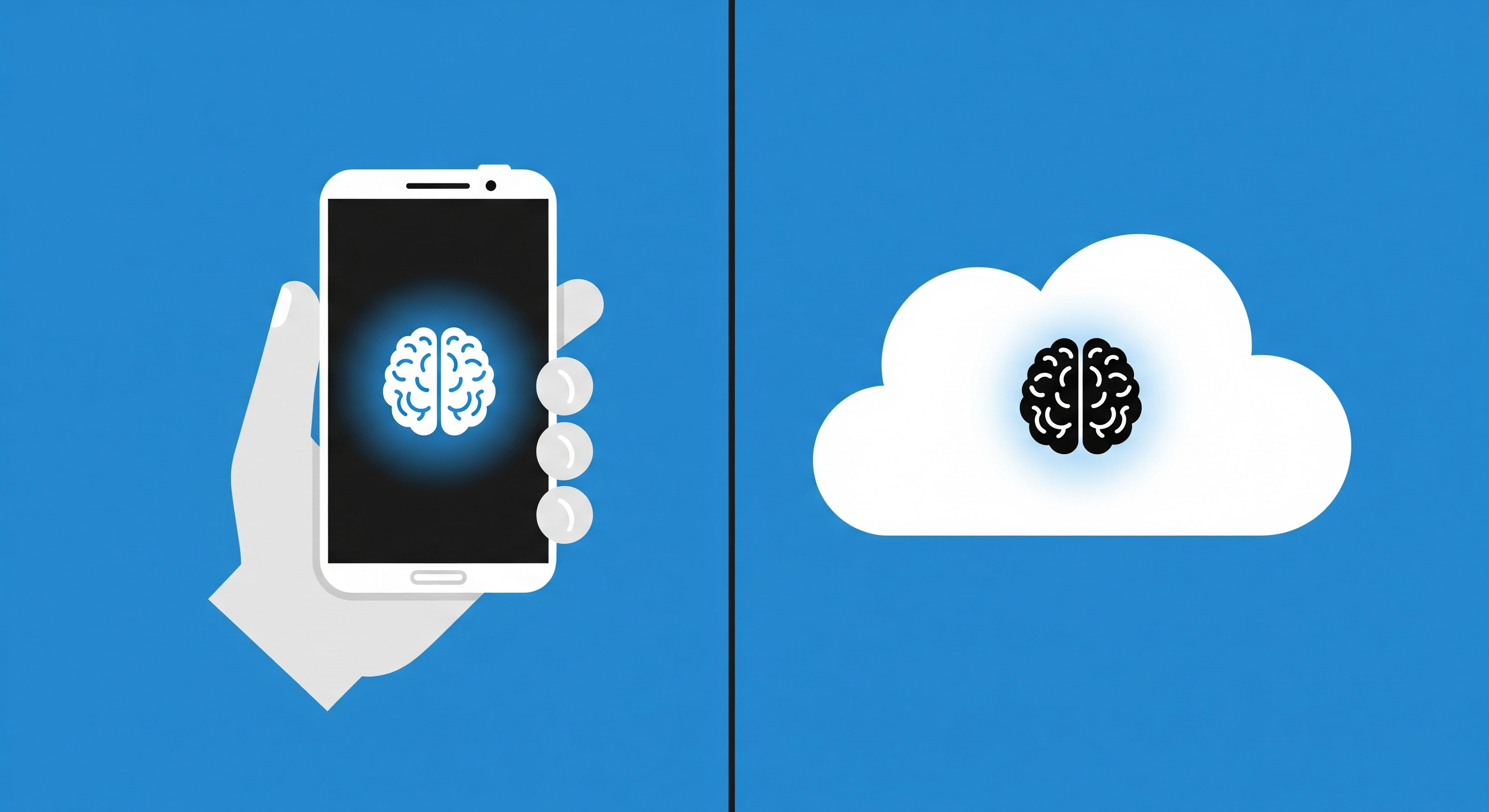
AI's Great Divide: The Brain in Your Hand or the Power in the Cloud?
The Narrative Hook: A Tale of Two Scenarios
Imagine a doctor in a remote clinic, hours from the nearest major hospital. A patient presents with a condition that requires an urgent, complex medical image analysis. The clinic's internet connection is unstable at best, but the AI-powered diagnostic tool on the doctor's device gives an instantaneous, life-saving assessment. Now, picture a factory manager on the other side of the world, whose entire production line relies on a robot making a split-second quality control decision. A delay of mere milliseconds, caused by sending data to a distant server and back, could result in catastrophic failure. In both scenarios, the stakes are incredibly high, and the outcome hinges on the speed, privacy, and reliability of the artificial intelligence at work. This introduces a fundamental question for any organization today: when lives, fortunes, and futures are on the line, how do we choose the right kind of AI?
The Core Concept: The Brain in Your Hand vs. The Brain in the Sky
Understanding the fundamental difference between Local AI and Cloud AI is not merely a technical debate; it is a crucial strategic decision that dictates control, cost, security, and competitive advantage. The answer to which is "better" is simple: neither. The real question is which is the "right fit" for the job at hand. The choice boils down to where the thinking happens.
Local AI, often called Edge AI, runs artificial intelligence models directly on a user's device—be it a smartphone, a laptop, or a dedicated server humming away in your office. It’s like having your own "private chef"; you control every single ingredient, ensuring your data stays in-house and is handled exactly according to your rules.
Cloud AI, on the other hand, leverages powerful remote servers managed by providers like Amazon Web Services (AWS), Google, or Microsoft. This approach is like "renting a spaceship"; you gain access to immense computational power and a vast universe of pre-built tools without having to build the rocket yourself.
This core distinction creates a cascade of important differences:
| Feature | Local AI (The Brain in Your Hand) | Cloud AI (The Brain in the Sky) | | :--- | :--- | :--- | | Execution | Runs on your own device or server. | Hosted on remote, third-party servers. | | Connectivity | Can work completely offline. | Requires a stable internet connection. |
These fundamental differences create a series of critical trade-offs that every business must consider before charting its AI course.
The Deep Dive: Deconstructing the Decision
To make an informed choice, we must dissect the five critical factors that define the schism between local and cloud intelligence: Privacy, Performance, Cost, Scalability, and Control.
3.1. Privacy & Security: The Fortress vs. The Public Square
For industries handling sensitive information, the privacy implications of AI are paramount. Local AI operates like a secure fortress. By processing information directly on-site, it keeps sensitive data "in-house," drastically reducing the risk of data breaches and avoiding the complexities of third-party cloud providers. This "privacy-first approach" makes it far easier to comply with stringent regulations like GDPR or HIPAA, as the data never has to leave the premises.
In contrast, Cloud AI requires sending data to remote, third-party servers for processing. This journey increases the data's exposure to cyber threats and can create significant data governance challenges, especially if the cloud provider stores data across multiple regions, complicating compliance with data residency laws.
The "Real World" Analogy: The Private Chef
The concept of Local AI as your "private chef" perfectly captures this. You have complete control over every ingredient (your data). You know precisely how it's handled, where it's stored, and that it's prepared according to your exact rules, without any risk of snooping or contamination from outside parties.
"Zoom In": The Healthcare & Finance Imperative
For sectors like healthcare and finance, uploading sensitive patient records or financial data to a third-party server is an "inherent risk." The data's journey to the cloud and back increases its surface area for attack. Local AI directly mitigates this by design. By processing that information on a hospital's local server or a bank's internal system, it ensures that the most confidential information remains firewalled from the outside world, turning a potential vulnerability into a source of strength.
3.2. Performance & Speed: The Reflex vs. The Relay Race
Performance in AI often comes down to one critical factor: latency, or the delay between a query and a response. Local AI excels here, processing data directly on the device for nearly instantaneous, "snappy" responses. This makes it ideal for applications that require real-time, split-second decisions.
Cloud AI, by its very nature, introduces latency. Data must travel from the device to a remote server, be processed, and then travel back. This round trip, however quick, adds precious milliseconds or even seconds, making it less suitable for applications where speed is a matter of safety or operational integrity, such as in autonomous vehicles or industrial automation.
The "Real World" Analogy: Reflex vs. Relay
Local AI's speed is like a human reflex—an instantaneous action processed without conscious delay. When you touch something hot, your hand pulls back before your brain even fully registers the pain. In contrast, Cloud AI is like a relay race. The baton (your data) must be passed from the user to the server and then back again. Each handoff, no matter how efficient, adds time to the final result.
"Zoom In": The Autonomous Vehicle
Consider an autonomous vehicle. Its sensors detect a pedestrian stepping into the road. With Local AI, the car’s onboard system processes this data instantly and applies the brakes—a reflex. If it relied on Cloud AI, the sensor data would have to be transmitted to a server, processed, and the command to brake sent back. That slight delay, that "relay race," could be the difference between a life-saving stop and a catastrophic failure. For such scenarios, offline functionality and near-zero latency are non-negotiable.
3.3. Cost & Economics: The Homeowner vs. The Renter
The economic models for Local and Cloud AI are starkly different. Local AI requires a significant upfront investment in hardware—powerful GPUs, servers, and cooling systems. However, after this initial capital expenditure, the ongoing runtime costs are minimal because all computation is done locally.
Cloud AI follows a "pay-as-you-go" model, which offers a very low entry cost. The appeal is undeniable, especially as costs have plummeted; between 2021 and 2024, the price to process a million tokens dropped a staggering 1,000 times, from $60 to just $0.06. This has made experimentation incredibly accessible. However, for long-term, high-volume use, the recurring expenses for data storage, data transfer, and compute power can "snowball" into a major financial burden.
The "Real World" Analogy: Buying vs. Renting
This financial trade-off is like buying a house (Local AI) versus renting an apartment (Cloud AI). Buying a house requires a large down payment and initial investment, but you build equity and your long-term costs stabilize. Renting is flexible and cheap to get into, but the monthly payments are perpetual and can increase unexpectedly over time.
"Zoom In": The Growing Company's Dilemma
The pay-as-you-go cloud model can be "detrimental to growing companies." A startup might find the low initial cost attractive, but as its application succeeds and its data transaction volumes explode, the cloud costs can increase dramatically. What began as a cost-effective solution can quickly become a significant long-term financial burden, draining resources precisely when the company needs them most for growth.
3.4. Scalability & Flexibility: The Skyscraper vs. The Custom Workshop
When it comes to handling massive and fluctuating workloads, the cloud is king. Cloud AI offers "virtually unlimited" scalability, allowing a business to ramp up its computing resources on demand to handle millions of concurrent users or process enormous datasets. Platforms like Hugging Face provide a vast library of pre-trained models that are essentially "plug-and-play."
Local AI, by contrast, is limited by the capabilities of the on-site hardware. Scaling up means physically adding more servers and GPUs, a process that requires significant planning and investment. While platforms like Ollama make it easier to run models locally, the physical constraints remain.
The "Real World" Analogy: Skyscraper vs. Workshop
The "Real World" Analogy here is Cloud AI as "renting a spaceship" that allows you to "grow without limits." If you need more power or room, you just request it. Local AI is like a custom-built workshop. It is perfectly tailored to your specific needs and gives you total control over every tool. However, you can't instantly add a new factory wing; expansion is a deliberate construction project.
"Zoom In": The Bottleneck of Success
While Cloud AI excels at scalability, it isn't immune to challenges. As a successful e-commerce application scales and its network and data transactions grow, its reliance on remote servers can become a bottleneck. This "network congestion" can lead to processing delays and higher transaction costs, degrading performance precisely when the application is at its peak popularity and user experience is most critical.
3.5. Control & Customization: The Private Chef vs. The Grand Buffet
The final deep dive centers on control. Local AI gives businesses "full ownership of their AI models" and the hardware they run on. This provides the freedom to "fine-tune" them with proprietary data or customize them for niche industry jargon, creating a unique competitive advantage.
With Cloud AI, the models and infrastructure are often "rented." Businesses have less direct control and are subject to the provider's infrastructure, policies, and updates. While many cloud platforms offer customization tools, the core technology remains in the hands of the provider.
The "Real World" Analogy: Chef vs. Buffet
Revisiting our culinary analogies, the "private chef" (Local AI) can tailor every dish to your exact dietary needs, flavor preferences, and secret family recipes. In contrast, the grand buffet (Cloud AI) offers an enormous, impressive selection of pre-made dishes. You have incredible choice and convenience, but you can't go into the kitchen and ask the chef to change the recipe of a dish just for you.
"Zoom In": Protecting the Secret Sauce
For a company that has invested years developing a unique, "proprietary algorithm," using a generic, pre-trained cloud model would be a competitive misstep. With Local AI, they can protect this "secret sauce." Their model, their data, and their methods remain entirely within their control, safeguarding the very innovation that sets them apart from the competition. For many, this ultimate trade-off between the convenience of the cloud and the sovereign control of local processing is the deciding factor.
The Walkthrough: A Startup's AI Journey
To see how these concepts play out in the real world, let's follow the journey of a hypothetical startup in the healthcare industry that wants to build an AI-powered tool for analyzing medical scans.
- Phase 1: Prototyping in the Cloud The startup begins its journey using a cloud platform like Hugging Face. The low entry cost and "plug-and-play" APIs are perfect for a small team with a tight budget. They can experiment with a wide variety of pre-trained models to quickly build a proof-of-concept and demonstrate their tool's potential to investors without having to purchase and configure expensive hardware.
- Phase 2: The Privacy Dilemma Their prototype is a huge success. Now, they need to transition to using real patient data, which is strictly protected by HIPAA regulations. Suddenly, their cloud model presents a challenge. The data journey is fraught with risk: sensitive scans are uploaded from the hospital, processed on a third-party server, and the result is sent back. This process introduces the "inherent risks" of data exposure during transit and on the provider's servers, as well as potential latency issues that could slow down a doctor's workflow in a busy clinic.
- Phase 3: Moving to the Edge To address these security and performance concerns, the startup shifts its core product to a Local AI framework like Ollama. They deploy their fine-tuned model directly onto servers within the hospital's own network. The data journey is now short and secure: the AI model runs locally, the analysis is instantaneous, and the sensitive patient data never leaves the hospital's premises. This move ensures both HIPAA compliance and the real-time performance doctors need.
- Phase 4: The Hybrid Future Years later, the company is a mature leader in its field. It adopts a sophisticated hybrid approach, inspired by Apple's strategy. They use Local AI for the core, real-time diagnostic tool, leveraging on-device hardware like Apple Silicon and the Neural Engine for on-device processing to guarantee privacy and speed. Simultaneously, when tasks become too complex, they offload them to "server-side foundation models" through a secure connection like Apple's "Private Cloud." This allows them to use Cloud AI to process vast, anonymized datasets for large-scale research, getting the best of both worlds: the fortress-like security of local for clinical use and the limitless power of the cloud for research and development.
This journey illustrates a critical truth: the choice between local and cloud AI is not a one-time, static decision. It is a dynamic strategy that evolves with a company's growth, priorities, and needs.
The "Explain Like I'm 5" Dictionary
Here is a quick glossary to demystify some of the key technical terms used in the world of AI.
-
Inference The process of using a trained AI model to make a prediction or decision based on new data. Think of it as... the AI using what it has learned to give you an answer, like a student taking a test after studying.
-
Latency The delay between a user's action and the time it takes for the system to provide a response. Think of it as... the lag time when you're on a video call with someone far away.
-
Scalability The ability of a system to handle a growing amount of work by adding resources. Think of it as... a restaurant's ability to serve ten customers as easily as it serves a hundred by adding more tables and staff.
-
GPU (Graphics Processing Unit) A specialized electronic circuit designed to rapidly manipulate memory to accelerate the creation of images, now widely used for AI computation. Think of it as... a super-powerful brain muscle specifically for doing the heavy lifting required by AI.
-
Edge AI An alternative term for Local AI, emphasizing that computation happens at the "edge" of the network, on the device itself, rather than in a centralized cloud. Think of it as... having a calculator in your pocket instead of having to call someone to ask them to do the math for you.
-
Tokens The basic units of text or code that an AI model processes; a word can be broken down into one or more tokens. Think of it as... the individual LEGO bricks that the AI uses to build or understand sentences.
-
Hybrid AI An approach that combines both Local (Edge) and Cloud AI, using each for the tasks it performs best. Think of it as... having a personal assistant on your phone for quick questions, but they can connect to a team of experts online for the really hard problems.
Conclusion: Choosing Your AI Compass
The journey through the world of Local and Cloud AI reveals that there is no single "winner." The debate is not about crowning a superior technology but about finding the right tool for the right job. The decision requires a careful balancing of priorities, a strategic choice guided by your organization's unique needs and values.
To help you find your way, here are the key takeaways to act as your compass:
- Choose Local AI when your non-negotiable priorities are unmatched privacy, real-time speed, and offline capability. It is the choice for applications where data security and instantaneous response are paramount.
- Choose Cloud AI when you need massive scalability, ease of use, and low upfront costs. It is the ideal starting point for experimentation and for applications that must serve a rapidly growing global audience.
- Consider a Hybrid approach to balance the strengths of both. This strategy allows you to create a flexible, secure, and powerful system that leverages local processing for sensitive tasks and cloud power for large-scale operations.
As artificial intelligence becomes ever more woven into the fabric of our professional and personal lives, the choice between local and cloud processing transcends technology. It becomes a fundamental decision about what we value most—be it the boundless, accessible power of the cloud or the secure, immediate, and sovereign control of a brain in our own hands.